


Need a Shipping Total?
Please chat, email, or call for a shipping total today!
Description
A reusable concrete cattle guard form is a simple and cost-effective solution to making as many of your own cattle guards as you like. These forms create a DOT highway safety HS20-Rated (16 tons per axle) guard. The straightforward process of making them means you won't be paying the high price for materials and construction or the shipping costs, as seen with traditional steel cattle guards, ever again.
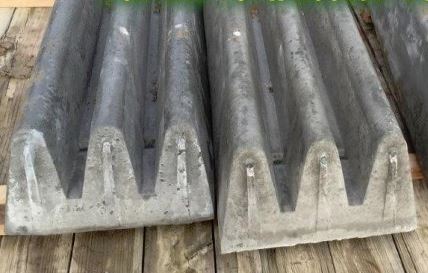
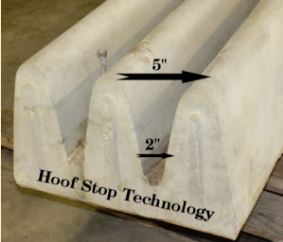
The form itself only weighs 75 pounds, and the finished product can be set directly in the ground! There's no need to dig a vault like a steel guard. This versatile design also provides extra safety for hoofed animals as they aren't able to slip a leg through the opening, unlike steel guards. The 5" gaps between the top ridges narrow to 2.5" and end at a solid bottom to prevent animals from sliding into the guard and becoming entangled or stuck in the barrier.
Safe, strong, and extremely economical, the livestock barriers you can make with these forms provide effective and secure containment on your farm or ranch without the hassle of using a gate.
Concrete Cattle Guard Specifications
- Simple, safe, economical, and reusable!
- Weight 75 lbs., the finished product can weigh 1,500 lbs.
- Make as many as you like!
- Be sure to use a release agent to avoid damage to the form
- Finished dimensions are approximately 6' L x 21.5" W
- HS20-Rated - 16 tons per axle - rebar not included
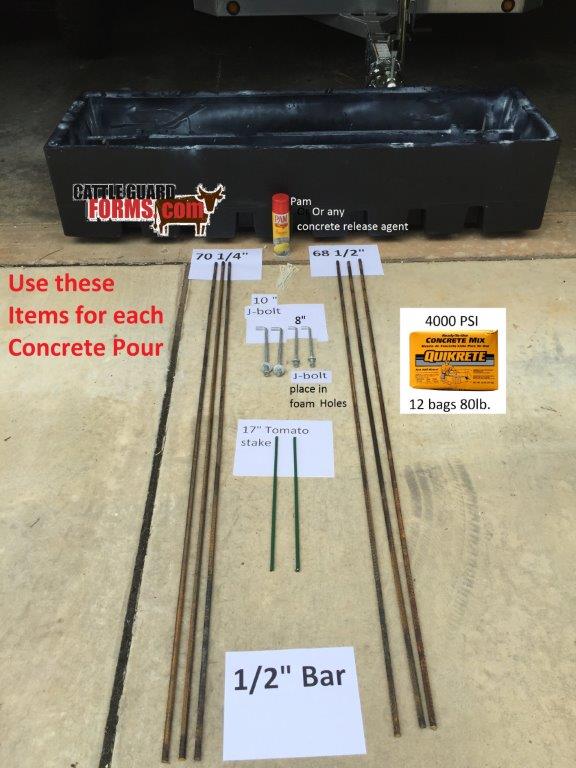
- Each pour requires 12 bags of 80 lbs., 4,000 PSI concrete mix, and 1/2" rebar
How to make your own cattle guard!
These forms create an engineer-rated, heavy-duty, reusable cattle guard that is very economical. P.E. Certified product that can handle the demanding load requirements set forth by the DOT, USFS, NP, BLM, and U.S. Military. The HS-20 rating is load-certified for 32,000 pounds per axle! The gaps measure 4.5 inches between beams and narrow to a defined bottom to help prevent animal entrapment.
Cattle Guard Spacing
Use a Release Agent
To help the finished form exit the mold, it is recommended to use non-petroleum release agents, like vegetable oil, Pam, or car wax. Since the form is made of polyethylene (plastic), certain release agents that are petroleum-based react with the plastic and can damage the form. A non-petroleum-based agent should be used to ensure a smooth release and avoid damage to the form while separating it from the finished cattle guard.
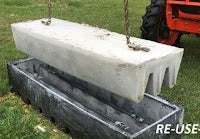
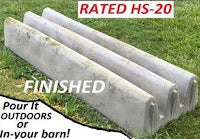
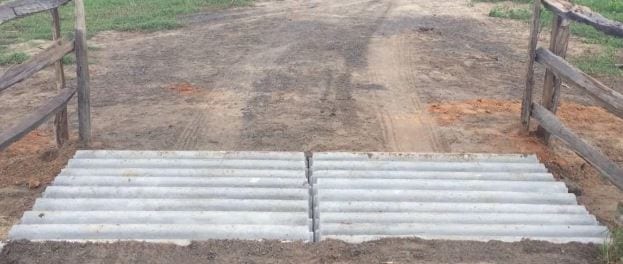
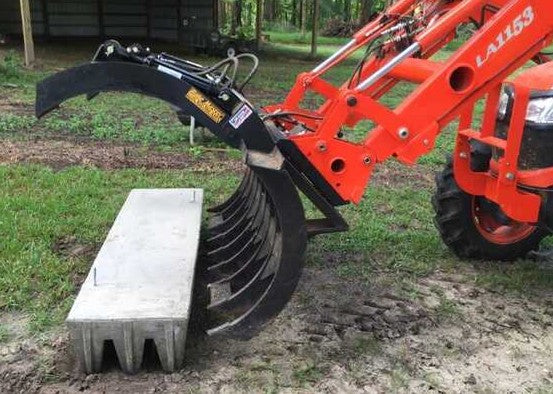
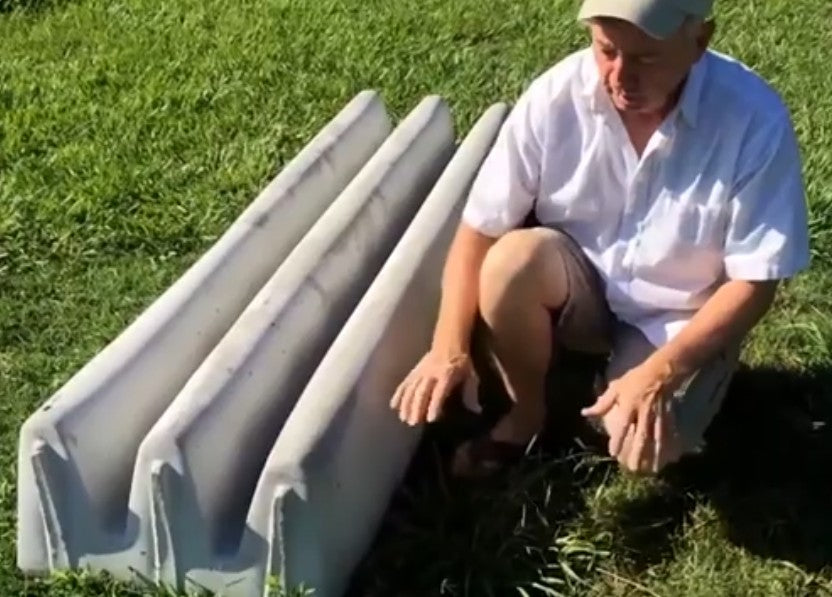
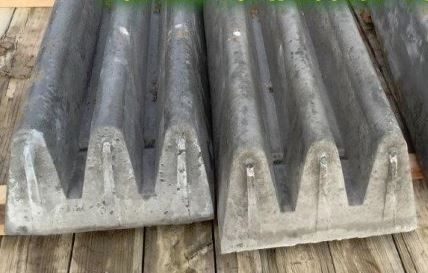
Finished Concrete Cattle Guard
EACH POUR REQUIRES 12 BAGS / 80 LB. / 4,000 PSI CONCRETE MIX & 1/2" RE-BAR
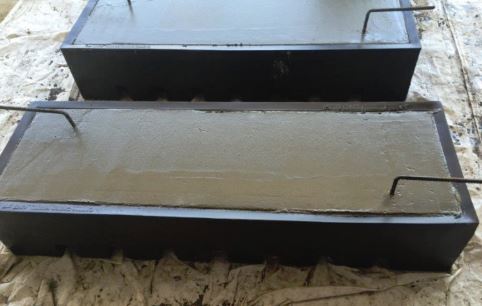
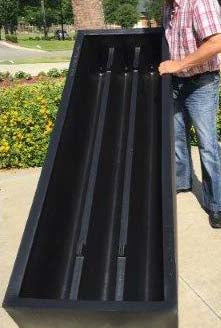
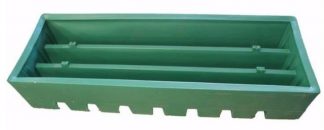
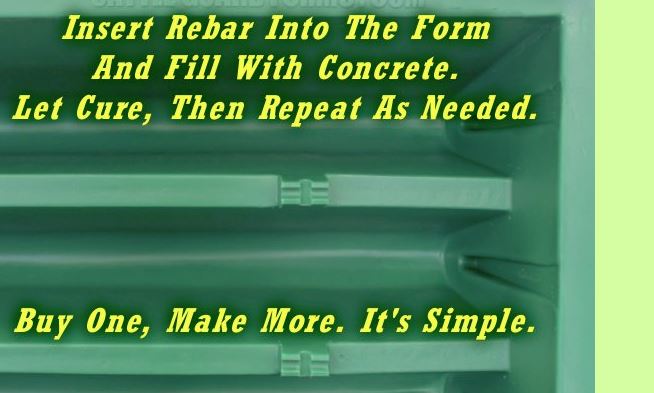
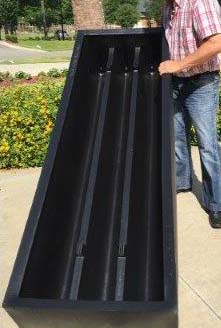
Inside the form
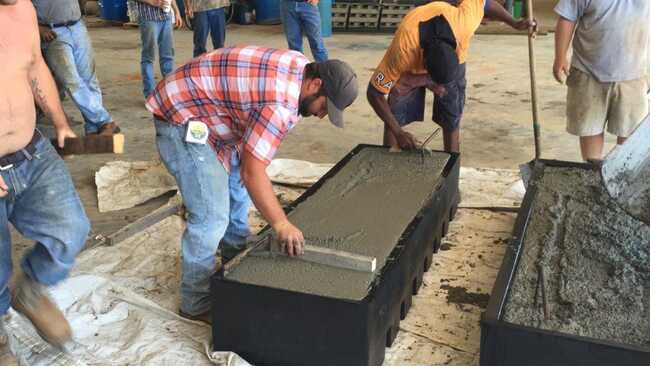
The video below gives valuable insight into how to pour your own cattle guards from an actual job. It has fantastic real-time comments from the owner of the company and plenty of tips on how to easily make your own livestock barriers. Learn how easy it is, from start to finish, as you watch how it's done simply and easily!
Please see more videos at the bottom of the page for a complete overview of the entire process. Here's a link for the larger leave-in-the-ground concrete cattle guard formand one in case you need a steel cattle guard.
Using the Cattle Guard Form
The reusable form allows you to pour your own HS20-rated cattle guards and make as many as you need. The form itself includes notches to hold your rebar in place, making it easy to set up before filling the form with concrete. Simply pour, allow the cement to dry and cure, and you’re done. Follow these general guidelines and watch the video above to see how simple the process really is.
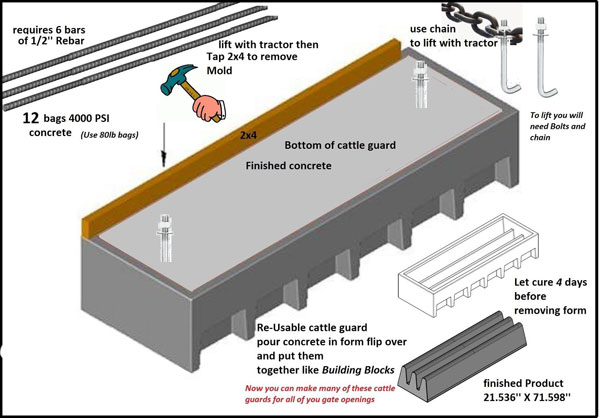
- Install the Re-bar: Slide your re-bar into the holding slots at the top and bottom of the form. You can use 1/2" or even larger if desired
- Tie in a J-bolt or other lifting point to remove the guard when cured
- Apply a release agent to the form to help the concrete exit the form when cured. Silicon-based and even plain vegetable oil works well.
- Fill the form with cement - each form takes 12, 80-pound bags of 4,000 psi cement
- Let the cement cure - it usually takes approximately four days
- Lift the guard and tap around the perimeter of the form to remove
- Set your new concrete livestock barrier in place
This process can be repeated as often as you need to make as many of these durable livestock barriers as you need. Please see the instructional video below for complete details on the ho make your own Texas Gates and set up your farm and ranch to be a secure, but gate-less facility. H20-rated grids are load-rated for 16 tons per axle, the same standards used by the DOC for public roadway installations.
Video on how to make your own cattle guard!
Cattle Guard Product Review
The following review synopsis provides insight into how easy and convenient it is to create a concrete cattle guard crossing. You simply fill the form with cement and rebar (not included), wait for it to cure, and then set it in place. You'll have a 16-ton per axle-rated livestock barrier that removes the inconvenience of opening and closing gates.
Ease of Making
The process of making our own cattle guards couldn't be simpler. The form is designed with the user in mind, ensuring that even those with minimal construction experience can achieve professional results. The detailed instructions included with the form guide you through each step, from preparing the site to pouring the concrete. The form's durable material ensures that it holds its shape perfectly, resulting in sturdy and reliable cattle guards every time.
Ease of Installation
Once the cattle guards are made, the installation is a breeze. The form allows for precise measurements and alignment, making it easy to fit the guards exactly where needed. We followed the installation steps, and within a short time, we had our first cattle guard in place. The design of the form ensures that the finished guards are not only functional but also aesthetically pleasing, blending seamlessly with our ranch environment.
Convenience of Making Multiple Forms
One of the standout features of the Cow Stop Cattle Guard Form is the ability to make as many cattle guards as needed. The form is reusable, allowing us to produce multiple guards without additional costs. This has been incredibly convenient for our growing ranch, as we can now create and install cattle guards at various access points without breaking the bank. The form's robust construction means it holds up well to repeated use, maintaining its integrity and performance over time.
Overall, the Cow Stop Cattle Guard Form has exceeded our expectations in every way. It has provided us with an efficient, cost-effective, and user-friendly solution for creating and installing cattle guards. I highly recommend this product to anyone looking to enhance their ranch infrastructure with ease and convenience.
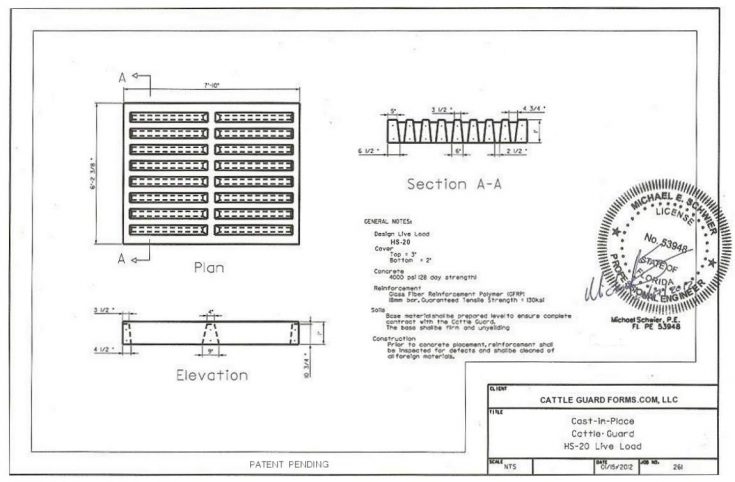
Diagram of cattle guard form
Advantages of Concrete Cattle Guard Forms
The most obvious is the cost! The form is reusable, and you can pour as many as you'd like to build in a do-it-yourself system.
Safer Cattle Guards for Horses
We don't recommend traditional cattle guards for use with horses, but much safer for horses and smaller hoofed animals.
On this design, the space between the tops measures 5" and it narrows quickly to only 2.5" at the bottom. Yes, there is a bottom and no vaulted, or dead-space area underneath for an animal's leg to slide into. This decreasing opening size and the lack of a drop below the guard help keep smaller-hoofed animals from getting a leg stuck or trapped between steel bars. If a hoof were ever to slide between the tops, it would be prevented from sliding too far, as it narrows quickly and prevents the hoof from sliding through the guard.
Reusable cattle Guard Forms allow you to make as many as you'd like
When using a form, you can make as many as you'd like. If you have multiple openings you'd like to prevent your livestock from crossing and don't want to worry about opening and closing gates, simply pour another cattle guard! No need to have multiple grids shipped to you when you can make your own. Most steel cattle guards will weigh 120 - 130 pounds per linear foot, making them difficult and expensive to ship.
Simple cattle grids without a box frame are often called ‘flat cattle guards’ and will typically have 4 channel beams underneath as support for the pipe overhead. Flat cattle guards will need to sit on a concrete footing, whereas boxed cattle guards will not. In fact, most steel cattle guards need to rest on a concrete footing or foundation since the supporting channel beams underneath are obviously too narrow to sit on bare ground.
Notice that some ‘flat’ cattle guards will only sit 6 to 7 inches off the ground (some actually resting on the ground!), making it much less of a cow deterrent. We’ve seen and have tried a few homemade cattle guard gimmicks, everything from wood slats to painted stripes, cinder blocks to highway guard railings, not to mention a few other embarrassing optical illusions. They work temporarily until a calf gets spooked or the herd discovers greener pastures just over the road. In the end, all of the cow-deterring gimmicks, tricks, and shortcuts simply fail.
Our engineering has revealed a few simple truths. To be effective, a cattle guard must be 10 to 12 inches in height, and not less than 6 feet from front to back. Beams separated by 5-inch gaps have proven to be the most effective and safest cow-deterring cattle guard design. Steel cattle guards may be ‘traditional’, but they’re extremely heavy and expensive, especially when you factor in the shipping and the concrete footing costs. The weight makes it difficult to offload from the delivery truck, and most steel companies hold the customer responsible for offloading with a forklift or tractor.
Finally, whether painted or exposed, given enough exposure to bad weather, steel cattle guards will rust and corrode at varying speeds. In fact, cattle guard corrosion is such an epidemic that it’s almost acceptable! Some companies sell rust-damaged cattle guards, and of course, the ongoing process of rust (oxidation) weakens the metal.
A Concrete Cattle Guard Costs Less, Yet It’s Stronger and Will Survive Longer than Steel.
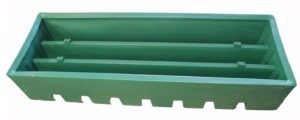
The form only weighs 140 lbs. before filling with concrete. Concrete cattle guards are a better, long-term option. Concrete is superior to steel in terms of strength, cost, and longevity. So, why is the traditional cattle guard constructed from steel? Well, precast concrete cattle guards are almost twice the weight of steel. Farm supply stores and individual customers simply can’t afford the shipping costs, let alone offload that kind of weight. However, Cattle Guard Forms are lightweight, the smaller form weighing only 79 lbs., and an 8 ft. by 6 ft. form is 150 lbs., even with the pre-installed GFRP rebar!
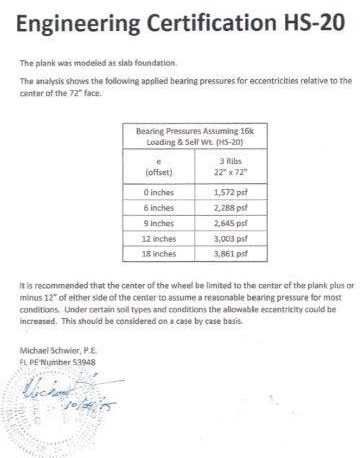
Set it in place, fill it with fresh concrete, and never have to move it or pick it up again. You’re done! Why HS-20 Cattle Guards? Do you know how much weight “economical” steel cattle guards can support? Neither do the retailers selling them! We are proud to say that our Cattle Guard Forms have been tested and certified to deliver an HS-20 (32,000 pounds/axle) load rating. Most ‘economical’ steel cattle guards will fail even under marginal loads, let alone the stress of a loaded semi, hay wagon, or dump truck. With that in mind, an HS-20-rated cattle guard will handle about anything you can fit between your gate opening. That’s one less thing a farmer should worry about.
By The Way, an HS-20 load rating means you can have a 5-axle semi-truck, with a max gross weight of 80,000 lbs. (DOT limit), and drive across it without a problem. The rating claims we provide are backed by a certified structural engineer’s sealed drawing attesting that Cattle Guard Forms properly placed and poured meet, or exceed, the rigorous standards for HS-20, which are used when specifying highways, bridges, and US Military construction.
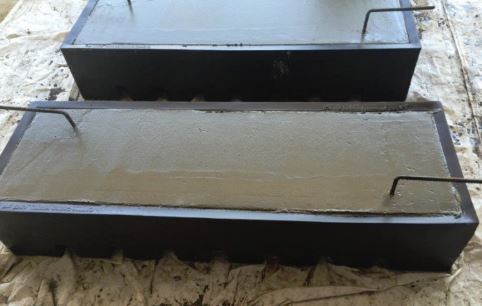
Here's what the form looks like, full of cement and waiting to cure. Notice the rebar added to make lifting the finished guard easier to remove the form.
We spoke with the manufacturer, and they recommended using any non-petroleum release agents, like vegetable oil, Pam, or car wax. Since the form is made of polyethylene (plastic), certain release agents that are petroleum-based can react with the plastic and damage the form.
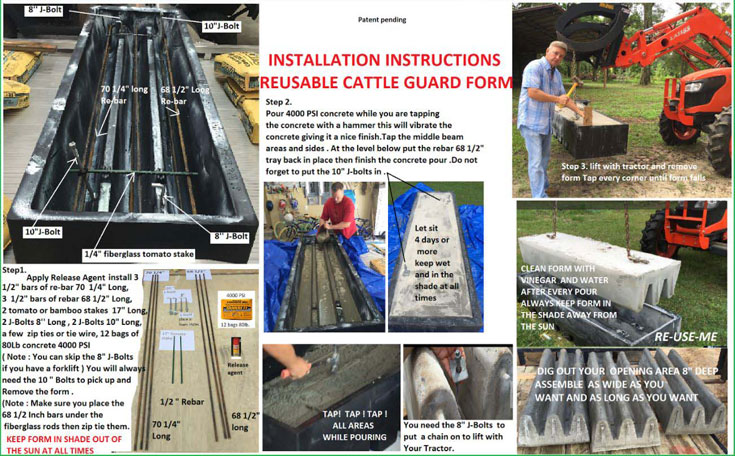
This quick illustrated construction diagram shows how straightforward it is to make your own concrete cattle guards:
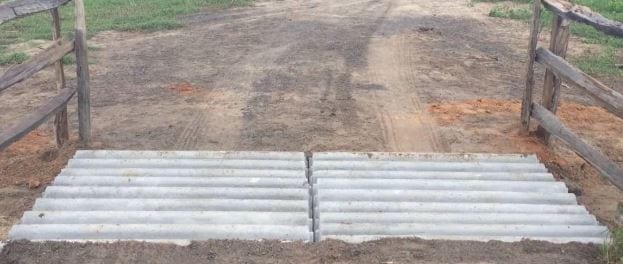
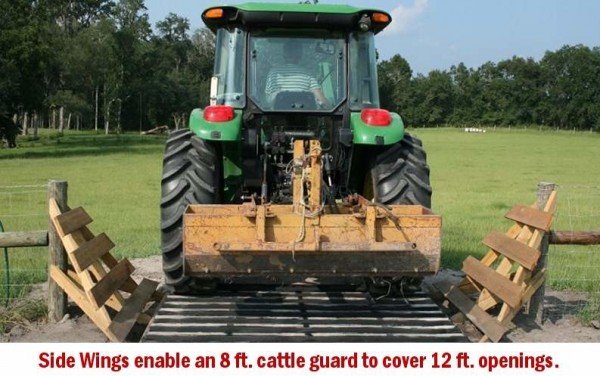
Here, a typical farm tractor crosses the concrete cattle grid and enters another pasture for mowing. No one had to get out and open a gate or fend off any cows!!
Concrete Cattle Guard Form Video Review
Built My Own Cattle Crossings and Saved a Ton
I’ve been running cattle for years, and when it came time to put in more cattle crossings, I started pricing out steel cattle guards. Let me tell you, by the time you add shipping to get one of those large, heavy suckers delivered way out here, it just ain’t worth it. That’s when I came across this reusable cattle guard form from Barn World, and I’m sure glad I did.
This thing is tough, well-built, and easy to work with. I poured my guards using the form, and it worked just like they said it would. I sprayed the inside of the form all over it before the pour, and once that concrete cured up, the form came off smooth as butter. No sticking, no cracks—just a solid cattle guard ready to go in the ground. I poured 12 in all for 2 crossings total.
One of the best parts is how many times I can use this form. I’ve already used it to make two separate crossings on different parts of the property. I plan to make a couple more before the summer's out. It’s a huge money-saver compared to buying separate steel guards every time. I figure I’ve saved a few thousand bucks easy—not just on the guards themselves, but also all that expensive shipping that comes with them.
The form is simple to set up, even for someone like me who ain’t a concrete expert. Just get yourself a good flat spot, follow the instructions, and pour. This setup is perfect for rural folks who want to get the job done themselves without needing to bring in a bunch of outside help.
It’s been holding up strong. I drive over it daily, and I’m impressed with how they're doing. Cows won't go near them, and I used crushed gravel for drainage. They haven't moved since I put them in. The form is a great investment for anyone who needs multiple crossings but doesn’t want to throw money away on steel or deal with the hassle of delivery out to remote areas.
Bottom line: it’s cost-effective, easy to use, and gives you the satisfaction of a job well done. I’d recommend it to any rancher who wants to keep cattle moving safely without breaking the bank.
John P - South Dakota