Cattle Guards


Cattle Guard Options
There are many different options to consider when choosing a cattle grid. Some of these include the type of traffic, the speed of crossing vehicles, and believe it or not, the type of animal that is being deterred. We don't recommend cattle guards for use with horses and some smaller hoofed animals (like goats) can trot right across. These livestock barriers are designed for cattle but can also be effective with deer if the distance created is large enough.
Below are some of the more common options and configurations available. If you have any questions or if we can help plan, design, or quote your project, please don't hesitate to ask. At Barn World, we'll be happy to help!
Top rails
The most noticeable difference between steel cattle guard designs is the shape of the top rails that run perpendicular to the roadway. Traditional construction uses a round steel pipe, usually, 3 1/2 to 4 1/2 inches in diameter welded directly to the support beams beneath. It's very difficult to balance a flat hoof on a rounded surface. The physical difficulty of balancing on an unstable platform means most cows won't step on the rail. It's too unstable to balance on and makes the round rail guard the most aggressive physical deterrent.
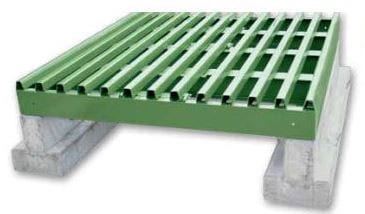
The 'flat top rail design' is shaped like a hexagon and has a flat surface on top of each rail. The large spacing between the rails prevents cattle from crossing. The hoof will tilt forward and backward creating the same type of physical discomfort as the round rail. The convenience created is the ride for high-speed traffic. It can cross without the vibrations felt in the round rail design.
Typically round rails are more economical and are very popular for private and slow traffic use while flat rails are seen in high-speed areas.
Steel vs Concrete
Steel construction is by far the most popular material but involves higher shipping costs and usually requires a foundation for support. These designs are structurally very sound and last for long periods of time. The steel itself is usually powder-coated or finished in enamel. They should be inspected occasionally and may require a paint touch-up as the years pass. The guards can be bolted to a foundation to prevent movement and fitted with wings to join fence lines.
Concrete cattle guard forms are fairly new and can be used to create very economical livestock barriers. The light poly material they're made with means shipping costs are much lower when compared to steel. The reusable form allows for pouring as many grids as needed and it can be stored for future use if more crossings are desired. This 'place in the ground' and permanent cattle guard form installation remains in the ground once the form is filled. It's a one-time-use design and is as easy as filling the form with cement.
One nice feature of the finished concrete design is that it prevents the hoof from sliding down between the top rails. The concrete forms its own foundation and the spacing between the top of the ridges diminishes until it reaches the finished bottom. This prevents the hoof from sliding down into a vault and exposing an animal's leg to breakage or becoming trapped in a steel grid.
Foundations
There are a few different options when considering a foundation for your cattle guard. It is the most important part of the installation and is critical for continued structural support for crossing vehicles. Some designs require concrete while others may only need to lay directly on the ground.
Directly on the Ground The simplest and easiest to install is the 'lay on the ground' design. This is popular in low-traffic, private-use areas that don't see a lot of continued use. Such installations require fairly flat ground and are used in driveways, oil wells, cell phone towers, and isolated pastures.
The steel cattle guard will have a skirt welded around the perimeter to keep dirt from creeping in underneath and entering the vaulted area. It is always recommended the site area be prepared with crushed gravel to facilitate proper drainage. A flat area is best and some installers will secure them to buried railroad ties. This can help prevent 'walking' when vehicles cross and provide overall security directly to the ground.
The concrete cattle guard has its own built-in foundation connecting the vertical barriers and is designed to rest directly on the ground. This installation also requires proper drainage and is most popular in driveways and pastures.
Concrete Foundations Public roadways and high-traffic areas usually require a concrete footing for extra stability, support, and security. These can be poured onsite or delivered as precast with the steel guard. Below is a picture of a flat, top rail cattle grid resting on foundations that were delivered together.
Load Ratings
Another very important consideration is the weight of the crossing vehicles. Public roadways require an engineer's certification as to the load capacity of the guard. For private use areas, the high load-carrying abilities of the highway ratings are not needed. These include areas like pasture entrances and driveways which are much more economical.
Highway projects require an AASHTO load rating of at least 16 tons per axle and special equipment crossing can require much more as shown in the chart below. Most farm equipment and loaded semi-trucks carry far less than 16 tons per axle.
Federal law controls maximum gross vehicle weights and axle loads on the Interstate System. Federal limits are 80,000 pounds gross vehicle weight, 20,000 pounds on a single axle, and 34,000 pounds on a tandem axle group.
ATV Cattle Guards
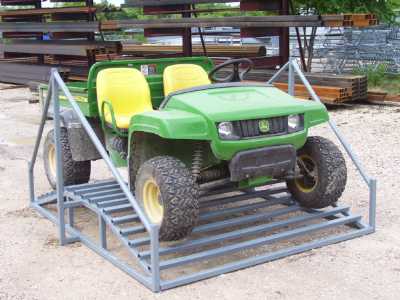
One of the newer and easy-to-install designs is a set-in-place crossing for all-terrain vehicles. It's a one-piece crossing designed for ATVs and provides quick pasture access through fence lines. It's very handy when checking a fence or moving between large pastures to check on cattle. To install, cut the fence, set it in place, and reattach the fencing to the center uprights. As with the other cattle crossings, create proper drainage. Also with this design, it's important to keep it from being overgrown with weeds. It prevents cattle from stumbling onto it because they can't see it.
Why A Cattle Guard Is It Better Than a Gate
A cattle guard, also known as a stock grid, cattle grid, or vehicle pass, is a type of obstacle used to prevent livestock, particularly cattle, from crossing a road or entrance, while allowing vehicles to pass freely. It consists of a series of parallel steel bars or tubes spaced closely together over a depression in the ground. The gaps between the bars or tubes are wide enough for a vehicle's wheels to pass through but too narrow for the hooves of livestock to navigate comfortably.
Here's a great blog post on why cattle guards are better than gates!
Cattle guards offer several advantages over traditional gates
-
Continuous Barrier:
Cattle guards provide a continuous barrier across the road or entrance, eliminating the need for manual intervention to open and close gates. This is especially beneficial in areas with frequent vehicle traffic and is easily appreciated during bad weather or when cattle are crowding the gate. -
Low Maintenance:
Once installed, cattle guards require minimal maintenance compared to gates. Gates can become damaged or wear out over time, requiring repairs or replacements, while cattle guards are generally durable and long-lasting. -
Convenience:
Because there is no need to open and close gates for each vehicle passage, cattle guards reduce the labor and provide easy access and convenience when passing through the barrier. This can be particularly important in large ranching operations where large equipment and trailers are constantly at work. -
Vehicle Access:
Cattle guards allow vehicles to pass through without interruption, promoting smoother traffic flow. This is especially important on roads where frequent stopping and starting can be inconvenient or unsafe. -
Cost-Effective:
While the initial installation cost of a cattle guard may be higher than that of a gate, the long-term cost of maintenance and labor is often lower, making it a cost-effective solution over time. -
Livestock Containment:
Cattle guards effectively deter livestock from attempting to cross by creating an uncomfortable surface for their hooves and creating an effective visual deterrent as well. These two factors combine to prevent cattle from escaping onto roads or into other areas where they could be in danger or become lost and difficult to round up. -
Piece of Mind:
No matter who is using a cattle guard, you'll never have to worry if a gate has been left open or come unlatched. You can sleep well knowing the cattle guard is constantly working!
Despite all of these advantages, cattle guards may not be suitable for all situations. They are most effective with cattle and similar hoofed animals, but they may not work as well for animals with smaller hooves or those that can easily jump or step on the rails. Additionally, they can be difficult for people to walk or cycle across.
Order a Cattle Guard Today!
Getting a cattle guard ordered and delivered to your site isn't complicated at all and they are the Ultimate Livestock Gate Due to the large sizes and weights involved, you will need to provide a mechanical means of unloading upon delivery. Usually, a set of forks or a tractor is sufficient for the grids.
Call Barn World at (720) 238-2190, email Sales@BarnWorld.com or chat below and we'll be happy to help with your project today!