Need a Shipping Total?
Please email or call for a quote with shipping and we'll be happy to forward one for your review.
See all of our cattle guards here!
Cattle Guards for extreme loads
If you're involved with a public roadway project, take a look at the DOT-required HS-20 load rating cattle guards at 16 tons/axle. These over-rated cattle grids are over-built for a whopping 25 tons per axle required by some heavy equipment, and off-road operations. Click the following link to view all of our flat top rail cattle guards.
An extremely heavy-duty cattle guard, this 10'er is engineered to the U-54 rating of 25 tons per axle!9 tons per axle, more than what is required by the DOT for public roadway construction. It is specifically used in off-road operations where the weights are greater than what is allowed on public highways. Typical examples include use for BLM logging operations, oil field equipment, and other heavy-duty equipment uses.
The guard measures 8' in the direction of vehicle travel and is available with the following options: wings so you may tie into your fence line, hinged clean-out sections, galvanization, and precast concrete footings.
Pictures of Installed Cattle Guard Crossings
An effective cattle guard provides a physical barrier by using small rails running perpendicular to the road that don't allow a flat hoof to balance on them easily. The discomfort and difficulty in walking provide an immediate deterrent to livestock and keep them from crossing. Below you can see the top rails forming the livestock barrier.
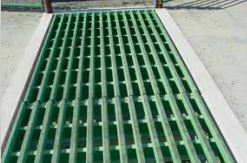
Cattle guard pictures
The U-54 load rating carries 25 tons per axle and is used when load carrying capacity exceeds that of what's required by the DOT for public road projects.

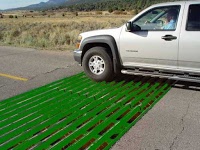
The flat top rail design allows cars to cross at higher speeds and much more smoothly than with the traditional round top rail design.
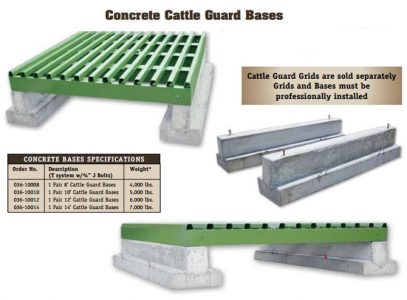
Cattle Guard Foundations
One of the largest headaches when installing a grid is the foundation work. These precast concrete footings ship directly with the steel grids and are designed to be set in the ground without the need for pouring cement. They include J-bolts already set into the concrete that allow the guard to be anchored down to prevent any type of movement.
Connecting your fence to the cattle guard
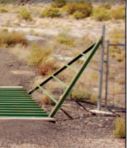
To keep your livestock from walking around the end of your fence line where it attaches to the grid, a triangular wing and post combination is used. The cattle guard wings attach directly to the steel and prevent the 'step around' when your fencing is secured. Below is a picture of the installed wings for a complete and effective livestock barrier.